Need help? Call us: (+98) 0234 456 789

 0.00
0.00




Related Blogs
No Blog Found!
Related Blogs
No Blog Found!
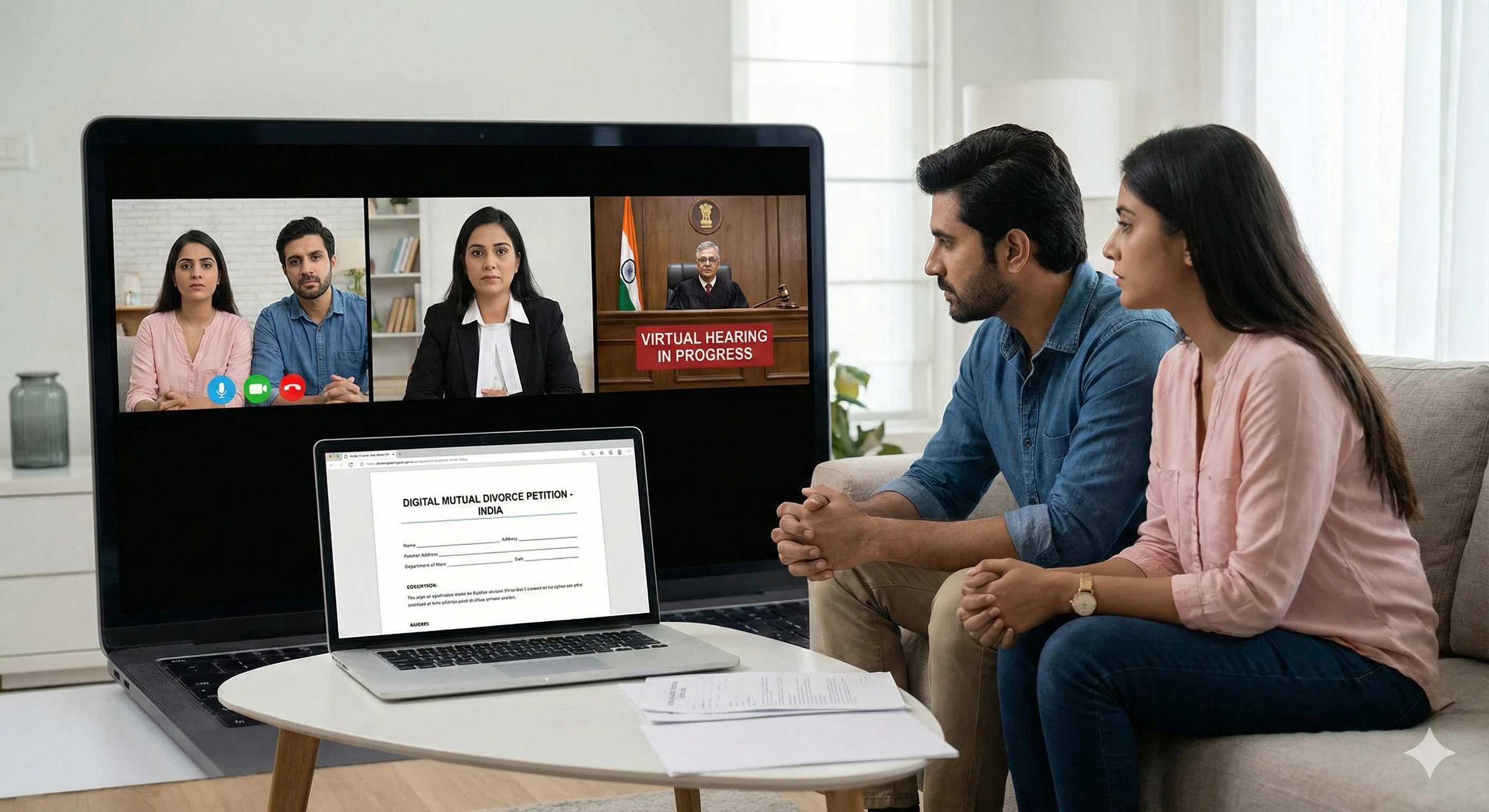
How to File Mutual Divorce in India Without Going to Court: Complete 2026 Guide
January 02, 2026
How to File Mutual Divorce in India Without Going to Court
Divorce is emotionally taxing; the legal process shouldn't make it worse. A common question in 2026 is: "Can we get a divorce without the hassle of physically going to court?"
The short answer is: Yes, largely. While India does not have a purely "online divorce" where you click a button and get separated, the judicial system has evolved. Thanks to digitization and Supreme Court directives encouraging technology, physical presence in the courtroom can now be substituted with virtual presence via video conferencing (VC) in mutual consent cases.
This guide explains the legally accurate process of obtaining a mutual divorce with minimal to no physical court visits.
Is It Possible to Get Mutual Divorce Without Physical Court Visits?
It is crucial to understand the legal reality. In India, only a Court can dissolve a marriage (under Hindu, Christian, Special Marriage Acts). There is no "notary divorce" or "administrative divorce."
However, "going to court" has changed significantly. Previously, couples had to physically stand before a judge multiple times. Today, if both husband and wife agree on all terms (alimony, child custody, property), courts are increasingly allowing the entire process to be conducted virtually.
Recent Government Rules & Virtual Hearings
The shift began during the pandemic but has now become a standard practice in many Family Courts across India. The Supreme Court has repeatedly emphasized that in matrimonial disputes, especially where parties reside in different cities or countries, video conferencing should be allowed to reduce burden and costs.
Key Legal Point: While the technology exists, allowing a virtual hearing is ultimately at the discretion of the presiding judge of that specific family court. However, in straightforward mutual consent cases, this request is rarely denied in 2026.
Step-by-Step Process of Online Mutual Divorce Filing
Mutual divorce under Section 13B of the Hindu Marriage Act (and corresponding sections in other Acts) involves two main stages: The First Motion and The Second Motion. Both can now be managed virtually.
Step 1: Drafting and Filing the Joint Petition (First Motion)
You cannot file this yourself on a website. You still need lawyers.
-
The Agreement: Husband and wife must agree on all terms. This agreement is usually drafted into a Memorandum of Understanding (MoU).
-
The Petition: Your lawyers draft a joint divorce petition based on the MoU.
-
E-Filing: In many states, lawyers can now "e-file" these documents onto the court's portal without physically visiting the registry.
Step 2: Recording Statements Via Video (The Virtual Hearing)
Once filed, the court assigns a date for the "First Motion" hearing. Instead of driving to the courthouse:
-
You, your spouse, and your lawyers receive a video link (e.g., Cisco Webex, Zoom, Vidyo).
-
You log in at the scheduled time from your home or lawyer's office.
-
The Judge verifies your identity on camera.
-
The Judge asks if you are taking the divorce voluntarily and if you have resolved your issues.
-
Your statement is recorded by the court staff while you are on video.
-
Outcome: The court passes the "First Motion" order.
The Mandatory "Cooling-Off" Period
After the First Motion, the law mandates a 6-month waiting period (cooling-off period) to give the couple a chance to reconcile.
-
Note: In rare, urgent cases, lawyers can file an application to waive this period, depending on the Supreme Court's guidelines, but this is not guaranteed.
Step 3: Final Decree Timeline (Second Motion)
Six months after the First Motion (and up to 18 months), you must file the "Second Motion."
-
If both parties still want the divorce, a Second Motion petition is e-filed.
-
A final virtual hearing is scheduled.
-
Similar to the first step, the judge confirms via video that both parties still want to proceed.
-
Outcome: The Judge grants the "Decree of Divorce." Your marriage is legally dissolved. The final order can often be downloaded online by your lawyer.
Documents Required for Mutual Divorce in India
To ensure a smooth e-filing process, ensure you have digital scans of these documents ready:
-
Proof of Marriage: Marriage Certificate OR Wedding Invitation Card along with marriage photographs.
-
ID Proof of Both Parties: Aadhar Card, Voter ID, or Passport.
-
Address Proof: Both current addresses.
-
Passport Size Photographs: Recent photos of husband and wife.
-
Income Tax Returns (ITR): For the last 3 years (often required to assess financial status, even if alimony is agreed upon).
-
Details of Assets Owned: If property division is part of the agreement.
Costs & Typical Timelines
-
Timeline: In the best-case scenario (with a 6-month waiting period), the process takes about 7 to 9 months from filing to the final decree. If the waiver period is granted, it could be as short as 2-3 months.
-
Costs: The Court Fees are nominal (usually under ₹200). The primary cost is legal fees for drafting, e-filing, and virtual representation. These vary significantly based on the lawyer's experience and location.
Common Mistakes Couples Make
-
Not Having a Clear MoU: Failing to document exactly who gets what (bank accounts, furniture, jewelry) before filing leads to confusion during the virtual hearing.
-
Skipping the Virtual Hearing: Treating a video link casually. If you miss the login slot, the judge may adjourn the matter for months or dismiss the petition.
-
Assuming "Online" Means DIY: You cannot navigate the e-filing portal or draft a legally sound petition without a lawyer.
When You Still Need a Lawyer
Even though you aren't visiting the court, the process is entirely legal. You need a lawyer to:
-
Draft a watertight Memorandum of Understanding (MoU) so that future disputes do not arise.
-
Correctly format and e-file the petition according to the specific High Court rules.
-
File the application specifically requesting a Virtual/Video Conference hearing.
-
Represent you during the video call and ensure your statement is recorded accurately by the court staff.
How AdvoLive Helps You With Online Mutual Divorce
AdvoLive simplifies the divorce process by combining legal expertise with digital convenience.
-
Vetted Virtual Lawyers: We connect you with experienced family lawyers who specialize in mutual consent divorces and are proficient with e-filing and virtual court procedures.
-
Remote Coordination: Our lawyers handle the drafting, coordination with your spouse’s lawyer, and all filings remotely.
-
Guaranteed Guidance: We ensure you are prepared for your virtual hearings so the process remains smooth and contactless.



Why Choose AdvoLive?
Verified & Experienced
LawyersInstant Availability
No Waiting100% Confidential
and SecureTransparent Pricing
No Hidden ChargesCopyright © 2026 ADVOLIVE. All rights reserved.
